Showing posts with label Machu Picchu. Show all posts

Friday, 3 May 2013

Four day trek to Machu Picchu


The Inca Trail 


Day 1

A 4.30am pick up awaited the group on the first trekking day. The group were taken to Ollantaytambo, a 2 hour coach trip deep into the mountains. The coach wasn’t exactly new and coupled with the terrible roads, the ride quality left its mark on my spine. A stop for an overpriced jam and egg roll later and we were off again 45mins further into the mountains to the start of the Inca Trail. The road / track surface depreciated dramatically, leaving our decrepid coach and my spine in tatters by arrival. On arrival we were welcomed by an army of short stout red men, clapping spiritedly by the possibilities of a 29 person tip.


The trek started gently with rolling wide shale paths alongside the Urubamba river. Some students had a rather sharp awakening to the weight of their bags and the reality of the task ahead. At this very early stage it was already easy to develop a hatred for the many trekkers hiring porters and an admiration for the underpaid army of porters carrying up to 28kgs along the trail like a swathe of ants.


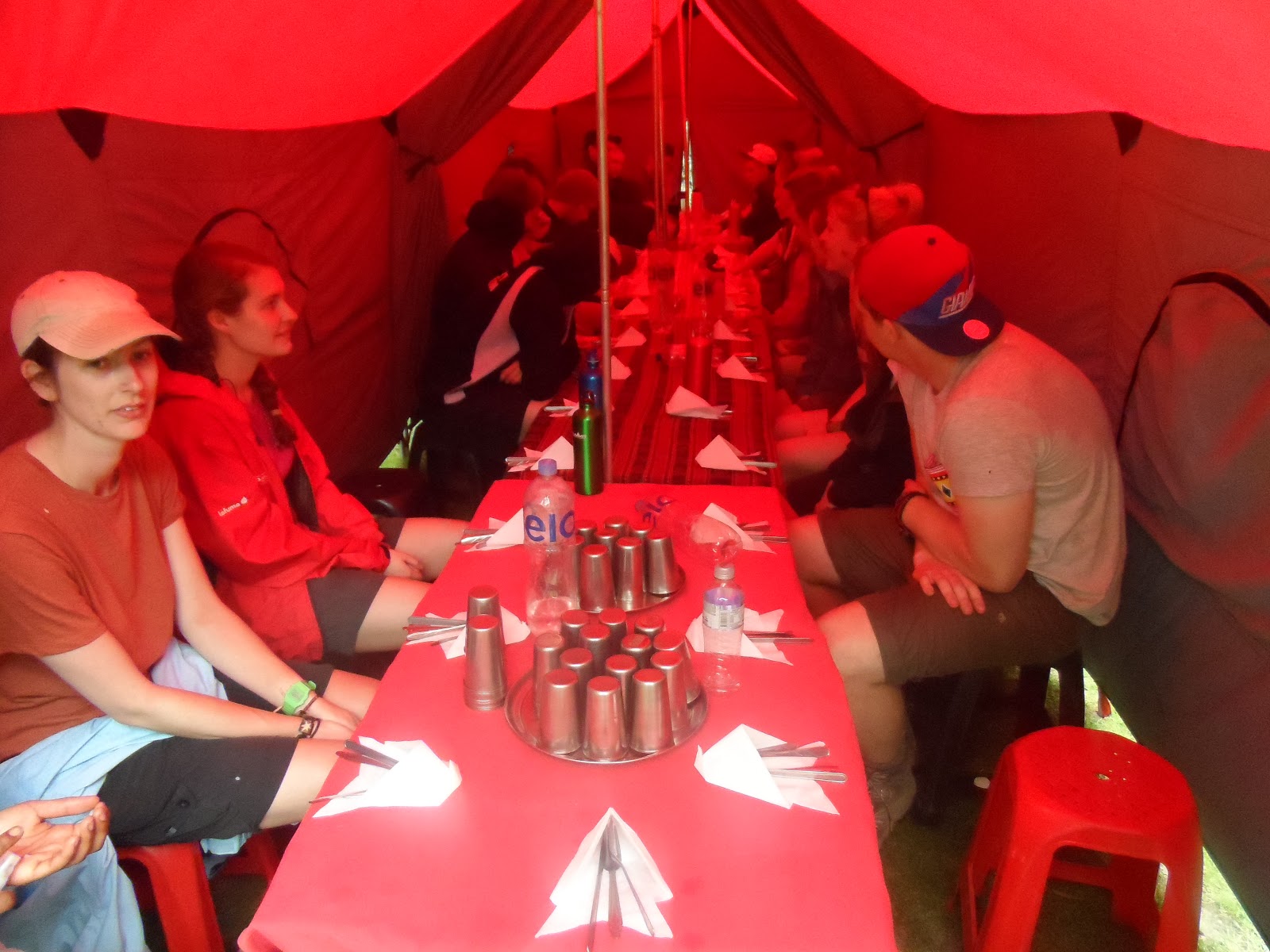
We awaited with some caution as we were thinking how much food could be brought up in bags and then cooked within 20 mins. However, we soon realized that Llamapath were keen to ensure we all ate very well – far better than we had the last couple of weeks. The food was excellent with four different starters.


After lunch we only had another 90mins up hill until camp. However the first real ‘uphill’ hit some people quite hard, soon realizing that uphill in Peru is properly uphill, no gentle slopes here.


Day 2

Day 2 is notoriously the hardest day of the Machu Picchu trek, many of us knowing this well before we left. However, to some this came as quite a horrible surprise. 


The path out of the campsite was a fairly sharp uphill from 7am all the way to the top of the mountain at dead woman's pass reached by the whole group at 10am. Some found it slightly harder than others and there were no shortage of grimaces and questions of fitness asked by the back end of the group.


The views along the route were incredible and made for good reasons to stop sporadically. By the top however much of the mist had drawn in and reduced the view slightly, though many by this point were just happy to sit down.


Fortunately from there until lunch the only way was down, a long way down. 


As lunch came the morning had taken its toll on some of the group, deciding that sleep was the best option.

In Inca style, a down hill is usually followed by a significant uphill and we weren't disappointed after lunch. Regretting eating the massive lunch supplied by the chefs we waded up the steepest steps seen on the trek so far. This lead all the way up to another pass and Inca look out tower.


After a another 2 hrs of up and down hills we finally reached another Inca fortress precariously sitting on a three sided cliff face, unknown as the inaccessible place. Sadly we were again scuppered by the mist with visibility of about 20ft. However, the lack of a view did not distract from the realisation of how ridiculous building on top of such a place was.

A further 30 mins a long a FLAT cobbley path lead us to the second campsite. For many this was a welcome sight. The day had been very long (10hrs walking mainly uphill) and had taken its toll on many. However, at dinner all was forgotten and the hot chocolate and coffee was greeted with cheers.


Day 3

The exertions of the previous day meant for some very tired bodies. Yet the sun was shining and the view were far better than the previous evening, showing a beautiful panorama of some the Andes highest mountains. 


The path was very different to the previous two days. Apparently we had now entered the 'eyebrow of the Amazon' and this was quite evident from the change in flora and forna and the ever present frog noises in the background (I was determined to see one).


The walk was far easier than the previous day, much of it fairly flat. Sadly by mid morning the mist had again rolled in, meaning the views were not great, even from the Inca look out towers dotted along the trail.


By mid morning  the terrain had become very jungle like, with the path becoming a fairly steady downhill with cobbley steps. This continued for at least 2 hours until it finally opened out into a beautiful valley.


Once at the opening of the valley and with the mist clearing it became apparent where we had actually walked. One of the most noticeable things on the trek and in the sacred valley is the seemingly impossible places at which the Incas decided to build terraces to grow crops. One of the largest and most remote of these was just before reached camp, located on a very steep mountain side looking over the valley. Complete with llamas it was quintessential Peru.


After this Inca site it was only a quick 20mins downhill to the camp, for a relaxing evening before the final day.

Day 4

Started VERY early, we were all up by 3am walking 20mins to the check point and then waiting at the front of the gate to make sure we got to Machu Picchu first that day. By 5am we were allowed through and made our way along an undulating path for 90mins to Sungate. However, Sungate should have been renamed mistgate, as sadly we could not see more than 20ft in front of us and what were supposed to be the first views of Machu Picchu were lost in the clouds.


A further 40mins along the path were arrived at Machu Picchu to everyones happiness and relief. Though the relief was swiftly followed with the disappointment at the view (See Below).


Fortunately after 30 mins the mountain gods heard our pleas for a view and the sun came out. We then had a tour of Machu Picchu with our guides and 2000 other tourists. 


Needless to say Machu Picchu was amazing and simply unexplainable. It was difficult to actually take in the enormity of the building work and architecture on top on a steep mountain side. No pictures could do the place justice. What truely does not come across in any pictures is the shear scale of the place and the height changes from the top to bottom. This is unquestionably one place that you must visit in your lifetime.


After a few hours looking around Machu Picchu we all got the bus down to Agas Calientes, a town developed entirely for tourism. The group spent the afternoon waiting for the train, enjoying the bars and restaurants. Some of us ventured uphill to the hot springs. On fist glimpse these springs looked very much like mud baths and a health hazard, yet once braved we realised why they were so popular. 


By 5pm we were all fully relaxed and ready to go home on the train back to Ollaytaytambo a 2 hour train ride, followed by a further 2 hour coach ride back to Cusco.


Overall the trek walk a great experience for all, it served as a physical and mental challenge for many. If you have the opportunity we cannot emphasise enough how worthwhile the trek is. Taking the train up just doesn't allow you appreciate all the other buildings along the trail that make Machu Picchu so much more special and important to the Inca people. 

Finally a big thank you to our guides, porters and chefs. The porters and chefs worked incredibly hard to make sure everything ran smoothly and that w ate so well for the 4 days.


Friday, 12 April 2013

Eager expectation

After a very relaxing day pottering around Cusco, bartering in the markets or perusing the museums, the team are now busy packing for tomorrow's trek to Machu Picchu. At 5pm the Llama Path trekking company came and gave us a talk about the trip and what to expect, with a few surprises regarding the wake up times and the expectation of tipping. (Surely you should not being asking for a set tip in advance - by definition a tip is in relation to the quality of service received??) Anyway, we are all in excited spirits and are preparing for our 4am wake up call and 4.30am departure.

The research kit will be coming with us. Mark has been presented with the unenviable task of carrying the scales, which are incredibly light but just an awkward shape to carry around for 4 days. These Seca scales were kindly provided by Cranlea medical equipment suppliers as the lightest available, they have been great so far - with an incredible amount of usage and knocking around. The other issue is that everyone will have to be completing their research daily diaries very early throughout the trek (between 3-5am everyday). This may make for some slightly disorientated or unhappy measurements going on in the dark.

Anyway, I for one am excited and am looking forward to the challenge that awaits. Roll on tomorrow...


Tuesday, 9 April 2013

Altitude Illness - Self Report

One of the main issues with travelling to Cusco is that as its at a high altitude (~3400 metres) it can lead to altitude illness. The most common type of altitude illness is Acute Mountain Sickness (AMS) which occurs in 20-70% of people going to high altitude. The symptoms of AMS are a headache as well as one of the following symptoms: nausea, vomiting, lack of appetite, dizziness or lightheadedness, sleeplessness and fatigue. In our group we have been completing an AMS questionnaire on a daily basis to measure the degree to which people have been developing symptoms associated with AMS. I am one of the people that have experienced symptoms suggesting that I have a poorer tolerance to altitude.

AMS. SpO2. Heart Rate
Day 1 morning. 5. 85. 66
Day 1 evening.  8. - -
Day 2 morning. 3. 85. 69
Day 3 morning. 4. 85. 69
Day 4 morning. 0. 94. 63
Day 5 morning. 0. 95. 72
Day 6 morning. 1. 92. 74

On the first full day in Cusco, even though I had a good long sleep the night before as I hadn't slept much on the plane journeys and I was already showing signs of AMS. I had a moderate headache, which is the main symptom of AMS as well as moderate light headedness. I also had an oxygen saturation of 85%, which was low in comparison with the rest of the group. Throughout the day the headache and dizziness became severe and I put an AMS score in the comments section as I felt it had significantly changed from the morning. The headache was very strong and had similar characteristics to a migraine as I struggled to cope with bright lights, therefore I was instructed to take ibuprofen. This did dull the headache down and allowed me to get a good nights sleep. If this had not improved my symptoms or had i felt as bad in the morning I would have been given Acetazolamide.

The onset of the illness usually in the first three days of reaching high altitude and usually lasts the same period. This is certainly the case with me as my questionnaire scores were greater in the first three days of the trip. In this period I consistently had a headache of a mild or moderate intensity as well as other symptoms. My saturation also stayed low at 85% while my resting heart rate remained relatively consistent. I found that the feeling was very similar to a hangover.

Those at greater risk of AMS are those who make a rapid ascent, people who have had a recent cold and retain fluid at altitude or do not urinate excessively at arrival at high altitude. Due to travelling from Eastbourne at sea level to Cusco this would make it a rapid ascent therefore predisposing people to the illness. Also on the first day I drank 4.5 litres of water, a bottle of coke and a cup of tea but only had five urinations. This suggests that I was retaining my fluids as well as not urinating excessively at arrival. Although i would have had a higher than normal sweat rate due to the excessive heat. I also experienced high altitude oedema in my ankles and lower legs which occurs more frequently in those with AMS.

After the first three days, my oxygen saturation significantly improved as well as my results on the questionnaire. This fits in with the idea that the illness occurs in the first days, after this period the results and my general feelings suggest that I have become acclimatised to the low levels of oxygen so that the necessary amounts of oxygen can be transported to the cells.

We haven't had any members of our group suffer with severe AMS, High Altitude Pulmonary Edema or High Altitude Cerebral Edema. This would be unlikely normally, but more so as our group are specifically measuring responses, very weary of symptoms and have been treating any symptoms early and appropriately. As we have gone past the time when you are most likely to have altitude illness hopefully nobody else will suffer with any altitude illness. We are carrying on the questionnaire and physiological measures to identify any problems that may arise. The next danger point is the increase in altitude along the Inca Trail which goes up to ~4200 metres but hopefully everyone will get through unscathed.

James


Monday, 3 September 2012

Peru 2013: Learning Through Adventure Project


Peru 2013: Learning Through Adventure

In 7 months, we will be taking twenty-four undergraduate students and five staff to Peru, to help rebuild a Peruvian school and teach some of the pupils over 10 days. We also intend to do some physiological research regarding altitude responses and adaptations and to climb Machu Picchu at the end of our stay. This blog is time-line of this process. People out there may be reading this for a number of reason; you may be interested in what we get up out there such as the physiological testing, you may be interested in the benefits we can create for these under-privileged children, some may be interested in the trek up to Machu Picchu and some may want to read this to help consider organising something like this for themselves or a large group like ours. Whatever it is I hope you find this interesting, useful and worthwhile. 


The School in Huarcarpay, Peru (30mins from Cusco) which we will be helping to rebuild and renovate. 


Sunny Eastbourne in the snow, altitude 0m, population 100,000 and Cusco, Peru, altitude 3300m, population 349,000.


Learning Through Adventure... Aims and Objectives

The Peru 2013 ‘Learning Through Adventure’ expedition is an initiative of the School of Sport and Service Management, University of Brighton. The initiative for year one students of our BSc (Hons) Sport and Exercise Science degree has three main objectives related to learning, research and cultural exchange.  Specifically, the initiative is focussed upon;


·         Education and employability
Peru 2013 will provide educational and employment-related experience for students through a number of means. Through planning and fundraising initiatives within the local community prior to the trip, students will have the opportunity to develop key employability skills important for future careers.  In addition, through working with children in the Peruvian community of Cuzco, students will develop cultural awareness and gain valuable life experience and self-realisation, which will be of significant benefit in their own lives as they develop their future careers.

From a formal educational perspective, the Peru 2013 initiative has been written and designed to align with independent study modules that students will take in their second year. Output from the expedition will form the basis for a 2000 word individual written report that will count as credit towards their degree. In addition, it is anticipated that research data generated on the trip will form the basis of oral and poster presentations.

·         Physiological Education Outreach
A key aspect of the ‘Learning Through Adventure’ initiative will be the outreach programme that the students will deliver to children living in schools in Cuzco. The intention for this programme is to teach basic human physiology to the children in a theoretical and practical way. Students from the BSc degree will prepare and deliver sessions over the duration of a week comprising basic insight into human physiology on topics ranging from the musculo-skeletal and cardio-respiratory systems to basic energy metabolism. The session content will be aligned with national curriculum guidelines to ensure appropriate level and where possible BSc students will use laboratory skills gained in the first year of their degree to implement practical sessions and ensure learning in a fun, active way.    The opportunity to gain hands on experience in teaching in an applied setting adds to the uniqueness of the project for the students. These life skills are not possible to teach in a normal academic environment, demonstrating the uniqueness of the venture.

·         Cultural exchange / volunteering
The Peru 2013 project is a rare opportunity to make a positive contribution to the lives of others and to experience a once in a lifetime trip to South America with the goal of aiding and educating the local community. The students will assume teaching responsibilities for orphaned and school children as well as implementing sporting activities and helping with the renovation and rebuilding of Huarcapay School. The volunteering project will allow the students to experience different cultures and most importantly make a valuable contribution to the lives of less-fortunate individuals. Continued trips to the region are planned to provide a real benefit to be seen in the community through the work of the students over a period of many years.


·         Research
Cuzco is approximately 10,000 km from London and situated at an altitude of 3,400m above sea level. Consequently, the expedition provides students with a unique opportunity to experience field-based, environmental research in the areas of altitude and travel across time zones. Opportunities to apply theory to practice and develop research skills will be provided through five research projects that have been developed in collaboration with the students prior to the trip. These projects will explore human tolerance to altitude and the impact of travel across time zones and will require laboratory based testing pre and post expedition, supplemented by field-based testing in Cuzco. It is anticipated that the data generated from the projects will form the basis of poster and oral presentations by the students, but will also contribute to writing journal articles for peer reviewed journals in the area of sport and exercise science.

Students using the Cortex Metamax 3X for Cardiopulmonary Exercise Testing (VO2max testing) in the labs

Currently

So to get you up to speed, we started organising this trip in January 2012, which is being booked through the very helpful Travel Nation. Students and staff are paying for this themselves and are actively fundraising through various projects to raise money to pay for the volunteering aspect of the project such as the building costs and set up. Such activities include quizzes, raffles, FIFA tournaments, netball tournaments etc. but I'm sure we will post more about these another time. We are doing only one sponsored event, a 10,000km static cycle, the distance from Eastbourne to Cusco, Peru. Again, I will post more on this later. We have so far gratefully received some funding and support from various companies for equipment and costs. These include MKKMad Designs Springboard and Cortex Medical, for whom we will be posting a running diary of the trip on their website . If anyone else would like to consider sponsoring the project in anyway please feel free to get in contact with me.

Please check out our other media places;

University Website
Twitter
Facebook 
Just Giving


Myself, the staff and students will keep you posted as to how we are getting on.

Thanks

Alan